VOICE-FIRST · FOLLOW-UP DRIVEN · NO SCRIPTS

The agentic AI interviewerthat follows up on exactly what you said.

One session. You'll know exactly what your answers sound like under pressure.

No credit card 1 free session Full report included

Engineers preparing for interviews at

MetaAppleAmazonNetflixGoogleOpenAIAnthropicMicrosoftNvidiaStripeDatadogSnowflakePalantirAirbnbUberShopifyAtlassianSalesforceAdobe
See the interview in action

Watch what happens when you gloss over an answer.

Alex reads your exact words. When you're thin — on a tradeoff, a service choice, a decision you skimmed — it follows up on that specific point. This is what makes practice feel different from rehearsal. See the full capabilities breakdown for everything behind the session.

Candidate: JohnExperience: 3 yearsTarget: Senior DevOps at Google
InterviewMesh live demo
SEE IT IN ACTION

Your interview, start to finish.

interviewmesh / dashboard
InterviewMeshAgentic mock interviews
MMikePROManageSign out
Track your progress and keep practicing
11Completed
72Avg Score
89Best Score
Your FilesManage resumes & job descriptions for A/B testing
Start New InterviewChoose your role and level, then practice with Alex

See your stats, access your files, and jump into a new interview in one click.

How it works
01
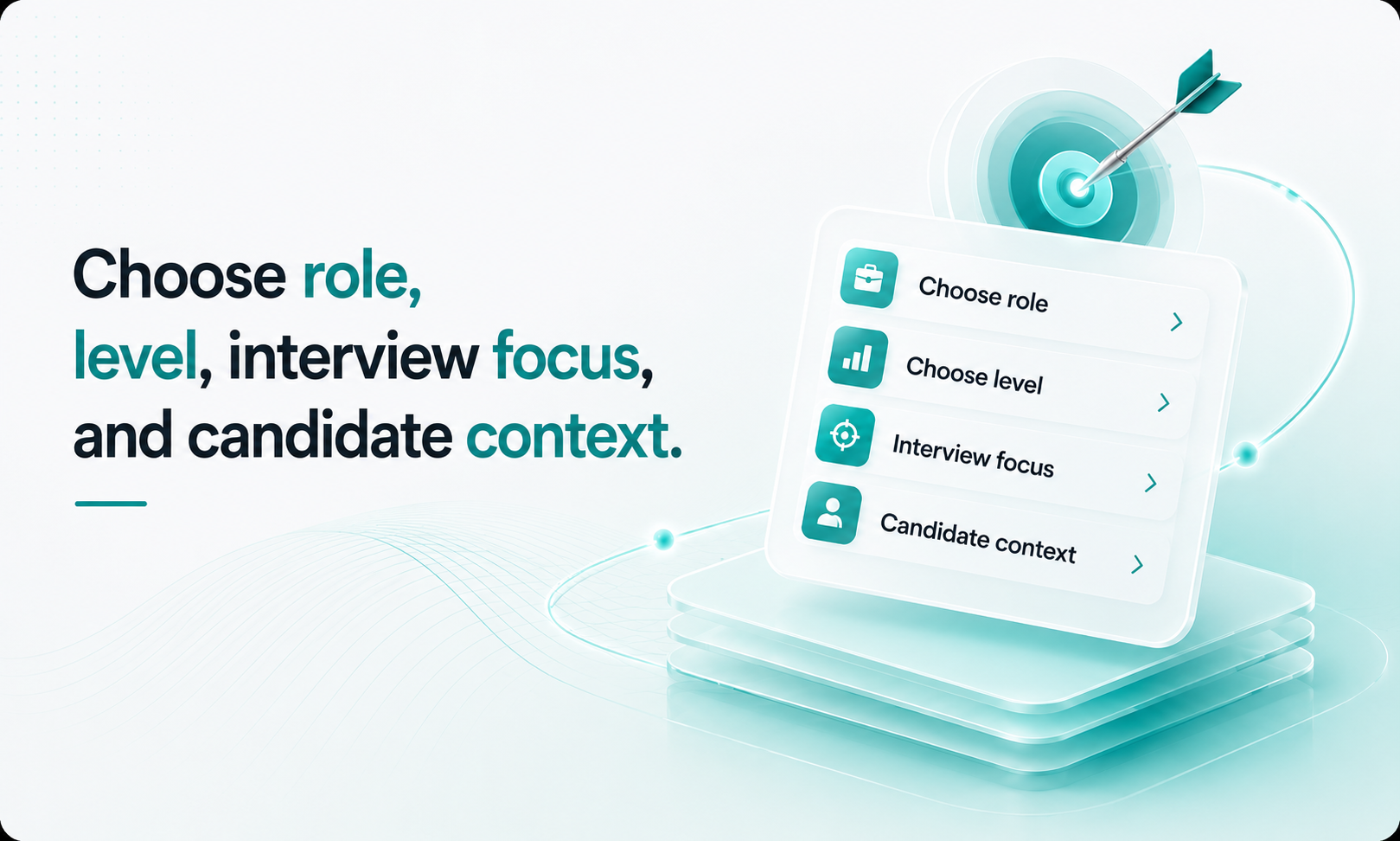
Tell Alex who you're interviewing for — and give it your resume and the job description.
19 live role tracks across Software Engineering, Cloud, Platform & Security, AI, LLM & Applied ML, Data & Analytics, and Product, Delivery & Business Systems. Add your resume and job description or a URL. Alex reads both before the first question and calibrates exactly where to probe.
19 live role tracksResume uploadJD context
interviewmesh/setup
Target role
DevOps EngineerSoftware EngineerData Engineer
Level
JuniorSeniorStaff
Context files
resume.pdf
stripe_sr_devops_job_description.pdf
Start Interview
02
Alex follows up on exactly what you said — no scripts, no hints
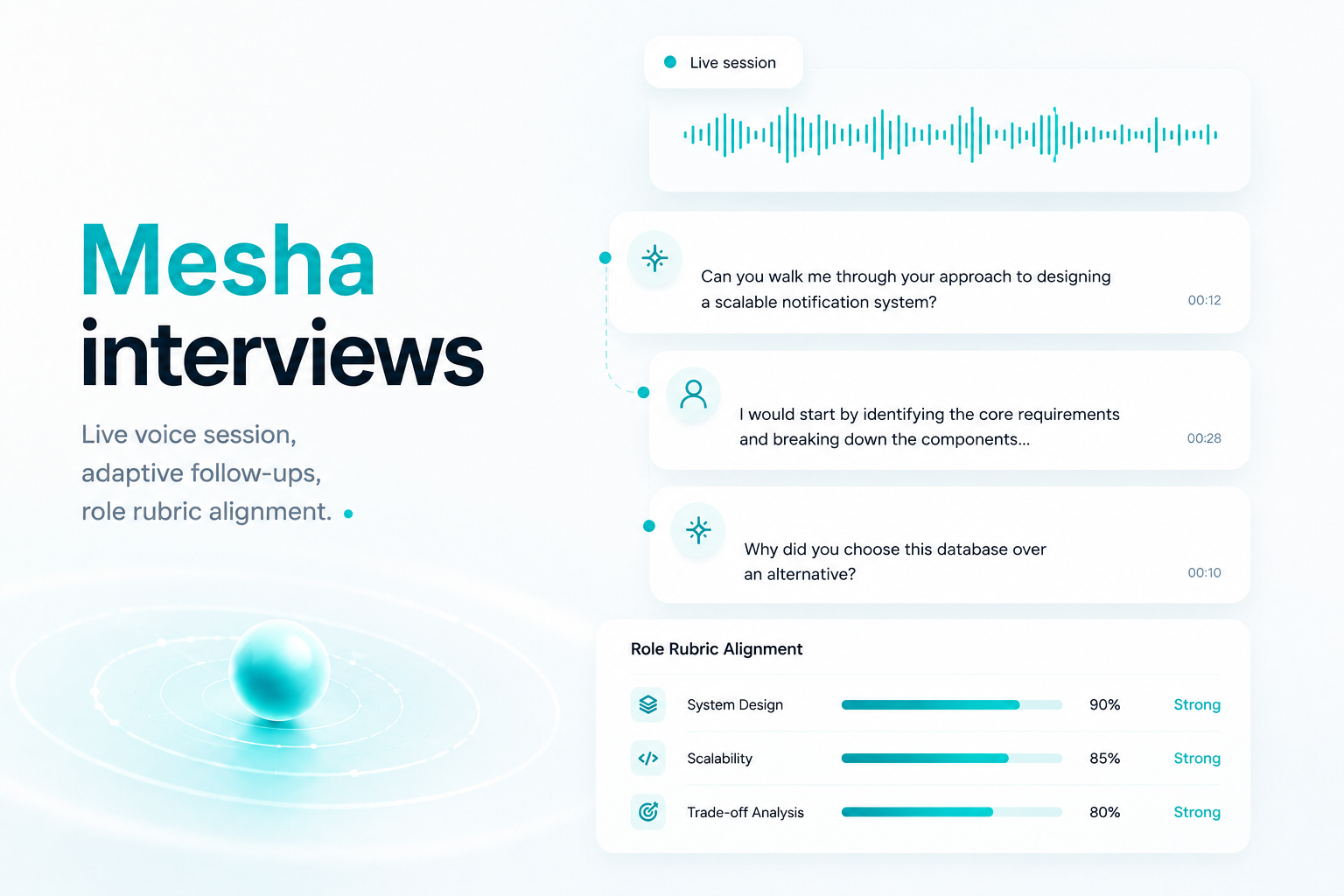
You answer out loud. Alex listens to your exact words. Mention a tradeoff and Alex asks about that tradeoff specifically. Reference a service and Alex probes why you chose it. This is where practice stops feeling fake.
Voice-firstTargeted follow-upsNo canned prompts
interviewmesh/live-session
Alex
Users report intermittent failures, but only some customers are impacted. How do you approach this?
You
I’d first check if the issue is isolated by segment, like region, tenant, or a specific service path. Then I’d look at recent deployments and dependency health to narrow down what’s affecting only that subset.
Alex
You mentioned segmenting by region or dependency. How would you confirm whether this is a downstream dependency issue versus something in your own service?
Listening for your next answer...
03
See the specific gaps in your answers, not generic scores
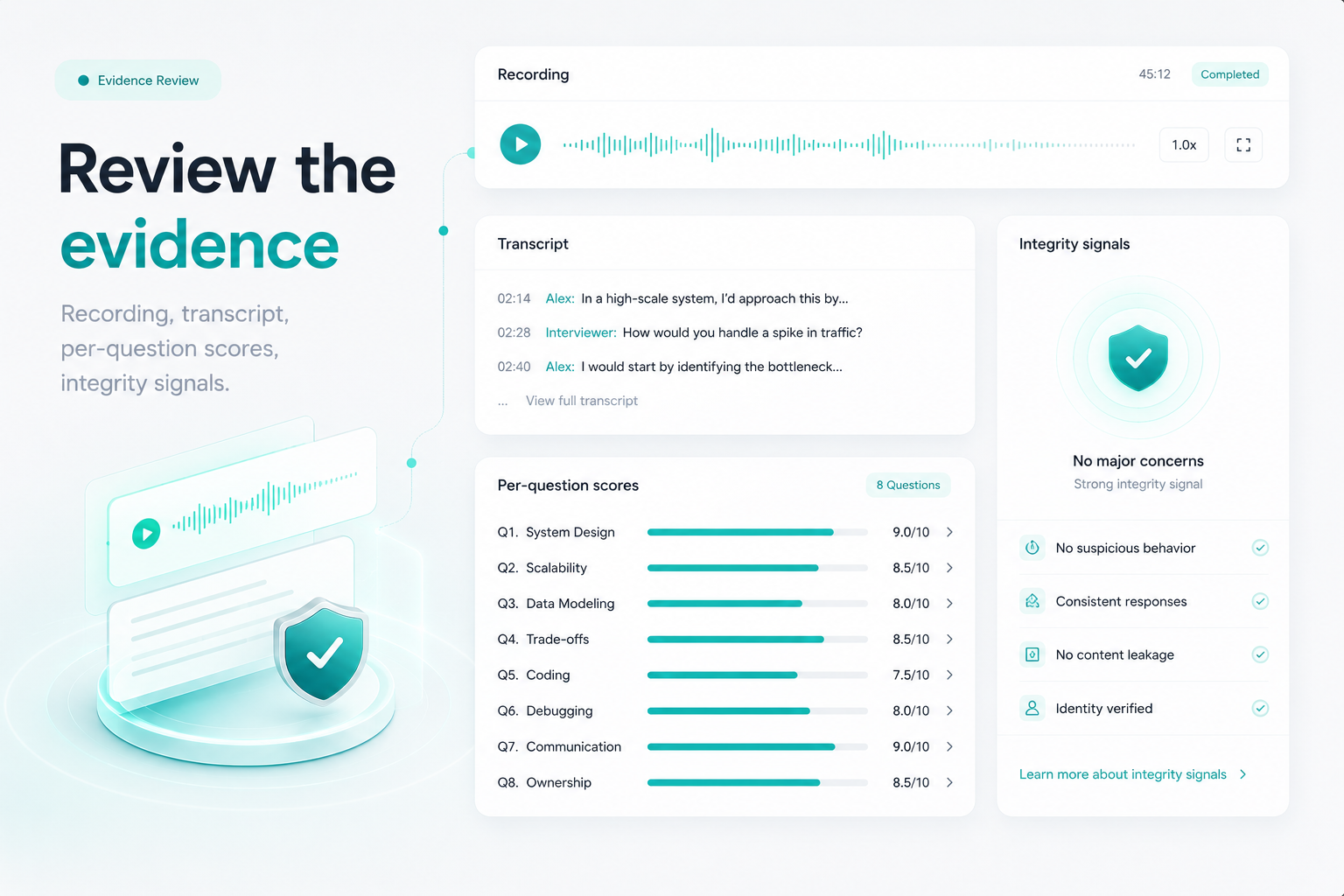
Every question gets scored across five dimensions — Technical Depth, Communication Clarity, Structure & STAR, Problem Solving, and Confidence Signals — with analysis quoting exactly what you said, what was missing, and a stronger answer to model against. The kind of feedback you usually only get from a hiring manager who is invested in you.
5 dimensions per questionStronger answer includedShareable verified report
interviewmesh/report
Overall score
Strong fundamentals, but thin on tradeoff detail.
84/100
Technical Depth
8.6
Communication Clarity
8.2
Structure & STAR
6.0
Problem Solving
7.4
Confidence Signals
8.0
What was missing
You identified segmentation and dependencies, but didn’t go deep enough on validation and action.
Stronger answer includes
Immediate mitigation — failover, circuit breaking, traffic shifting — not just investigation.
That’s the missing senior-level detail — moving from diagnosis to controlled recovery under uncertainty.
Session Integrity

Know if your practice reflects real skill — or just comfort with the tool.

Every session is analyzed across 10 behavioral signals — response timing, phrasing patterns, vocabulary range, and turn structure. If the score reflects genuine performance, the integrity check confirms it. If patterns suggest AI assistance or surface-level answers, it flags it. Individual candidates use it to know their real level. Enterprise teams use it to screen for AI-assisted responses in remote technical rounds.

10 behavioral signalsPer-session analysisVerifiable hash ID

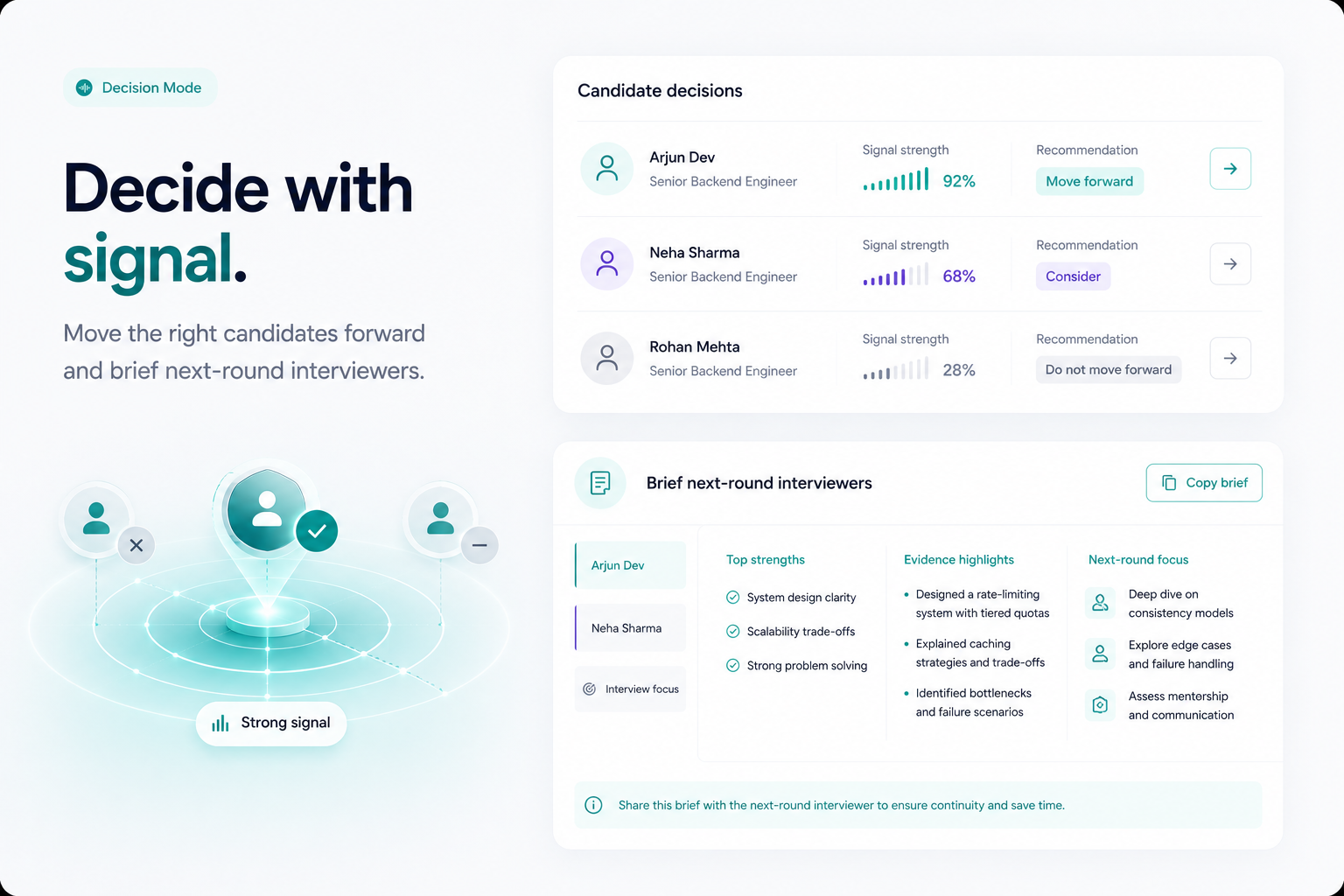
Enterprise teams use this layer to detect AI-assisted responses in remote technical screens. Individual candidates use it to know their real level — not their AI's level.

interviewmesh/session-integrity
Verified · #8373D078F867
Clean
Signals detected2 / 10
LOW RISK
Response timingNatural variation
Turn structureHuman cadence
Vocabulary varietyContextual range
Phrasing patternsStructured style
Cross-question refsConsistent thread
Role Coverage

Your exact role, your exact level. One of 19 live tracks.

Pick the role you're interviewing for — Software Engineer, DevOps, AI Engineer, Data Engineer, Product Manager, and more — at Junior, Senior, or Staff calibration. Alex reads your resume and JD before the first question. The session focuses on what matters for that role, at that level, at that company.

Software Engineering
Backend, full-stack, and test-engineering interview loops under real delivery pressure.
Includes Software Engineer, Full Stack Developer, and SDET Engineer.
3 rolesJunior to Staff
Cloud, Platform & Security
Infrastructure, reliability, cloud architecture, and security-focused interview tracks.
Includes DevOps Engineer and Cybersecurity Engineer.
2 rolesJunior to Staff
AI, LLM & Applied ML
Generative AI, LLM, ML engineering, safety, prompt, and solutions-oriented loops.
Includes AI Engineer, LLM Engineer, and MLOps Engineer.
8 rolesJunior to Staff
Data & Analytics
Data platform, modeling, experimentation, and analytics interview depth.
Includes Data Engineer and Data Scientist.
2 rolesJunior to Staff
Product, Delivery & Business Systems
Product, project, analyst, and business-systems interview tracks with execution pressure.
Includes Product Manager, Project Manager, and Salesforce Business Analyst.
4 rolesJunior to Staff
Software Engineering
Backend, full-stack, and test-engineering interview loops under real delivery pressure.
Includes Software Engineer, Full Stack Developer, and SDET Engineer.
3 rolesJunior to Staff
Cloud, Platform & Security
Infrastructure, reliability, cloud architecture, and security-focused interview tracks.
Includes DevOps Engineer and Cybersecurity Engineer.
2 rolesJunior to Staff
AI, LLM & Applied ML
Generative AI, LLM, ML engineering, safety, prompt, and solutions-oriented loops.
Includes AI Engineer, LLM Engineer, and MLOps Engineer.
8 rolesJunior to Staff
Data & Analytics
Data platform, modeling, experimentation, and analytics interview depth.
Includes Data Engineer and Data Scientist.
2 rolesJunior to Staff
Product, Delivery & Business Systems
Product, project, analyst, and business-systems interview tracks with execution pressure.
Includes Product Manager, Project Manager, and Salesforce Business Analyst.
4 rolesJunior to Staff
Testimonials

"It picked up on small details in my answer and forced me to go deeper instead of skating by on a polished summary." — Daniel Kim, Senior SWE

What candidates say after their first few sessions with Alex.

I used InterviewMesh before two backend interviews and it helped me notice how often I gave incomplete answers. The follow up questions felt sharp in a good way. By the third session I was speaking more clearly and with less panic.
This was the first mock interview tool that actually pushed on my architecture choices instead of just accepting buzzwords. I liked that it asked why I picked one service over another. That made the practice feel much closer to a real panel.
The strongest part for me was the pressure to explain tradeoffs out loud. It exposed where my thinking was solid and where I was leaning on vague language. The report after the session was specific enough to be useful.
I usually feel prepared until I have to explain my reasoning live. InterviewMesh made that gap obvious very quickly. After a few sessions I was giving more structured answers and less rambling ones.
The follow ups were what sold me. It picked up on small details in my answer and forced me to go deeper instead of skating by on a polished summary. That is exactly the kind of pressure I wanted to practice.
I liked how natural the conversation felt compared with text based prep tools. It was uncomfortable at first, which honestly made it more valuable. The feedback helped me tighten how I talk about prioritization and stakeholder decisions.
A lot of tools make you feel confident too early. This one made me earn that confidence. It was especially helpful for system design because it kept pulling on the weak parts of my explanation until I had to be precise.
I used it to practice explaining incident response and security tradeoffs. The questions were clear and the follow ups caught where I was being too generic. It helped me sound more grounded and less rehearsed.
What stood out to me was how detailed the post interview breakdown was. It did not just tell me I needed to improve. It showed where my answer lacked depth and what a stronger version should have included.
InterviewMesh was useful because it did not let me hide behind high level terminology. If I mentioned model choice, latency, or tradeoffs, it pushed deeper. That made the practice feel much more human and much more honest.
Solid tool. The follow-up questions are genuinely sharp and the post-session breakdown is more useful than anything I have gotten from a text-based prep tool. My main gripe is I wish there was a way to jump back into a previous session. Still, the practice quality is high and it made me noticeably better at structuring my answers.
Good product, does what it says. The AI interviewer pushed on my answers in ways I did not expect, which is exactly the point. I knocked off a star because the session setup could be smoother — took me a few tries to get the right role calibration dialed in. But the actual interview quality is strong.

Try it free. Your next interview
doesn't have to feel like the last one.

One session. Ten minutes. You'll know exactly what breaks when you're actually under pressure. No credit card required.

1 free session · full report · no credit card